
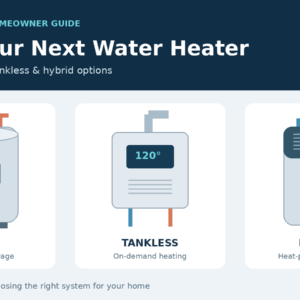
Best Water Heaters for Philadelphia Homes: Tank, Tankless, and Hybrid Options
Choosing a new water heater involves more than picking a brand or replacing your existing tank with the same size. The right system should meet your household’s hot-water needs, fit your home’s layout, and make sense for your installation budget.
For Philadelphia homeowners, the main choices are traditional storage-tank water heaters, gas tankless systems, and hybrid electric water heaters. Each has advantages, but the best fit depends on your fuel source, available space, and how much hot water your household uses at once. The U.S. Department of Energy recommends evaluating demand, efficiency, and installation requirements when comparing options.[energy]
This guide compares several water heater product lines and answers the questions homeowners should ask before scheduling a replacement.
Which Water Heater Brands Should You Consider?
Start by comparing the type of system you need, then narrow your options to specific models. A manufacturer’s product lineup can include different capacities, efficiency ratings, and features, so the brand name alone should not determine your decision.
Bradford White: Traditional Gas Tank Options
Bradford White is an option for homeowners comparing conventional gas storage-tank water heaters. Its Defender Safety System incorporates technology designed to resist the ignition of flammable vapors outside the water heater.[bradfordwhite]
If you already have a gas tank, ask your installer whether a comparable replacement meets your current hot-water demand and installation requirements. A like-for-like replacement and a conversion to a different technology should be priced as separate options rather than treated as equivalent projects.
Rinnai SENSEI: High-Efficiency Tankless Options
Rinnai’s SENSEI RX lineup includes condensing gas tankless water heaters with efficiency ratings up to 0.98 UEF. UEF, or Uniform Energy Factor, is a standardized measure used to compare water-heater efficiency.[rinnai]
Rinnai’s RXP models also include a recirculation pump and Smart-Circ technology, which learns household usage patterns and schedules recirculation accordingly. These features are worth discussing if reducing the wait for hot water is a priority, although the plumbing configuration affects how the system operates.[rinnai]
Navien NPE-A2: Tankless With Built-In Recirculation
Navien’s NPE-A2 series is another gas tankless option. Its ComfortFlow system combines a built-in recirculation pump with a small buffer tank designed to reduce the brief burst of cold water that can occur between closely spaced hot-water uses.[navieninc][navieninc]
When comparing Navien and Rinnai, look beyond the headline efficiency rating. Ask about the exact model’s hot-water output, recirculation setup, installation requirements, warranty, and service needs.
Rheem ProTerra: Hybrid Electric Options
Rheem ProTerra hybrid electric water heaters use heat-pump technology to move heat from the surrounding air into stored water. The lineup includes models with connected monitoring and leak-protection features, although equipment specifications vary.[rheem]
A ProTerra may be worth evaluating if you are considering a move away from gas water heating. Before choosing one, have the installer check the proposed location, electrical supply, drainage, and required clearances.
Bradford White AeroTherm and A. O. Smith Voltex: Additional Hybrid Choices
Bradford White’s AeroTherm and A. O. Smith’s Voltex product lines provide additional heat-pump water heater options. Both offer different capacities and model configurations, making it important to compare the specific equipment proposed for your home rather than relying on a brand-level comparison.[bradfordwhite][hotwater]
Is a Tankless Water Heater Worth It for a Philadelphia Home?
A tankless water heater can be a good choice if you want a compact system and continuous hot water without waiting for a storage tank to refill. Tankless units heat water on demand rather than keeping a tank of water hot throughout the day.[energy]
However, continuous hot water does not mean unlimited output. Your system must be able to handle the fixtures operating at the same time. Multiple showers, a washing machine, and other hot-water uses can exceed the capacity of an undersized unit. The Department of Energy notes that some households may need more than one tankless heater to meet simultaneous demand.[energy]
Before switching, ask your plumber to evaluate:
- Your peak simultaneous hot-water demand.
- The selected model’s output at the required temperature rise.
- Gas supply and piping capacity.
- Venting requirements.
- The complete installation cost.
A tankless conversion should be evaluated as a complete project. Existing gas piping and venting are not automatically suitable for the new equipment.[energy][navieninc]
Should You Replace a Gas Tank With a Hybrid Electric Water Heater?
A hybrid electric water heater is worth considering when your existing gas tank reaches replacement time, but the installation location matters.
Heat-pump water heaters need appropriate air space, temperature conditions, clearances, and condensate drainage. The electrical supply must also match the selected model. These requirements can make one basement or utility room suitable while another needs modifications.[bsesc.energy]
Your installer should assess:
- Whether the room meets the manufacturer’s airflow and temperature requirements.
- Whether the unit fits, including service clearances.
- How condensation will drain.
- Whether electrical upgrades are necessary.
- Whether the proposed tank can meet your household’s hot-water demand.
Some heat-pump replacements may need a larger tank than the gas unit they replace to provide the desired hot-water performance. Compare the complete conversion cost and estimated operating costs using your actual utility rates—not a generic savings promise.[bsesc.energy][energy]
What Size Water Heater Do You Need?
The right water heater size depends on how your household uses hot water, especially during its busiest period.
Two homes with the same number of occupants can have different requirements. Back-to-back showers, large tubs, and overlapping appliance use all affect demand.
Sizing a Storage-Tank Water Heater
For a tank system, compare the unit’s first-hour rating with your estimated peak-hour demand. The first-hour rating reflects how much hot water a fully heated unit can deliver during one hour, including the water it reheats during that period. Tank capacity alone does not provide the complete picture.[heatpumpdata.energy]
Rather than choosing a replacement based only on your existing tank’s gallon capacity, explain to your installer when you run out of hot water and which fixtures typically operate together.
Sizing a Tankless Water Heater
For tankless equipment, sizing depends on flow rate and temperature rise—the difference between the incoming water temperature and the desired delivery temperature.
For example, Navien lists the NPE-240A2 at 11.2 gallons per minute with a 35°F temperature rise, but 5.6 gallons per minute with a 67°F rise. This illustrates why the maximum advertised flow rate is not the output you should assume under every condition.[navieninc]
Ask your installer to size the system for your expected incoming-water conditions and simultaneous fixture use.
Rinnai vs. Navien: Which Is Better?
Rinnai and Navien both offer high-efficiency gas tankless water heaters. A useful comparison focuses on specific models rather than declaring one brand the winner.
Rinnai SENSEI RXP models include Smart-Circ technology that learns usage patterns and schedules recirculation. Navien NPE-A2 models include ComfortFlow, combining a recirculation pump with a buffer tank.[rinnai][navieninc]
The better choice for your home depends on the required hot-water output, plumbing configuration, installation scope, and service support. Ask the contractor to explain why the proposed model fits your home and how its recirculation system would work.
Recirculation can reduce the wait for hot water, but it is not free from trade-offs: system configuration matters, and recirculation can increase energy consumption.[rinnai][navieninc]
Will a New Water Heater Require Changes to Your Existing Setup?
Possibly. A straightforward replacement is different from switching fuel sources or water-heating technologies.
Switching From a Gas Tank to Tankless
The installer must verify gas-pipe capacity and follow the selected unit’s venting requirements. Do not assume the connections serving your old tank can be reused without changes.[energy][navieninc]
Switching From Gas to Hybrid Electric
The project may involve electrical work, condensate drainage, and adjustments for the new unit’s dimensions, airflow, and service clearances.[bsesc.energy][energy]
Replacing a Similar Water Heater
Even a similar-unit replacement must meet applicable installation requirements. Philadelphia requires a plumbing permit for water heater replacement, and electrical alterations may require an electrical permit. The city also identifies a Water Heater Certification Form as required installation documentation.[phila][phila][phila]
Have the contractor identify these requirements before work begins so you understand the scope and cost.
What Should a Water Heater Installation Estimate Include?
A clear estimate should help you compare complete installations—not just equipment prices.
Ask for a written breakdown identifying:
- The manufacturer, model, capacity, and fuel type.
- Installation labor and materials.
- Removal and disposal of the existing heater.
- Permit fees and who handles the permit process.
- Any gas piping, venting, electrical, or drainage modifications.
- System startup, testing, and cleanup.
- Equipment warranty and any workmanship warranty.
- Exclusions or conditions that could change the price.
For a Philadelphia installation, confirm who is responsible for the required plumbing permit and water heater certification documentation. These should be addressed as part of the project rather than left unclear until installation day.[phila][phila]
Plan Your Philadelphia Water Heater Replacement
The right water heater starts with an assessment of your home—not a one-size-fits-all brand recommendation. Compare equipment that meets your hot-water demand, understand the installation changes, and review a written estimate before deciding.
Contact Best price plumbing to schedule a water heater assessment in Philadelphia. We can review your existing setup, discuss suitable tank, tankless, and hybrid options, and explain the work involved in your replacement.
Water heaters to feature
| Brand / product line | Suggested angle for your article | What to highlight |
|---|---|---|
| Bradford White gas tank water heaters with Defender Safety System | Traditional gas tank replacement | A strong option to discuss for homeowners comparing conventional gas tanks. Bradford White’s Defender system incorporates flammable-vapor ignition-resistant technology. [bradfordwhite] |
| Rinnai SENSEI RX / RXP | High-efficiency gas tankless option | The RX line offers efficiency ratings up to 0.98 UEF. RXP models add a built-in recirculation pump and Smart-Circ technology that learns usage patterns. Explain that recirculation performance depends on the plumbing configuration. [rinnai][rinnai] |
| Navien NPE series | Another gas tankless option to compare | Include Navien alongside Rinnai rather than presenting only one tankless brand. Philadelphia-area contractor comparisons identify the NPE series as an available installation option; select the specific model after evaluating the home. [mccorrycomfort] |
| Rheem ProTerra Hybrid Electric | Energy-efficient electric water heater upgrade | Uses heat from the surrounding air to heat water. Rheem offers models with Wi-Fi monitoring and leak-protection features; specifications vary by model. [rheem] |
| Bradford White AeroTherm Series G2 | Contractor-installed hybrid alternative | Available in 50-, 65-, and 80-gallon capacities, with app connectivity, Wi-Fi, and Bluetooth. Useful for comparing hybrid options beyond Rheem. [bradfordwhite] |
| A. O. Smith Voltex hybrid electric | Additional heat-pump comparison option | The Voltex lineup includes ENERGY STAR-certified models and different tank capacities. Compare the exact model’s efficiency, capacity, and warranty rather than treating the whole brand as one product. [hotwater] |
1. Which water heater is best for your Philadelphia home?
The best water heater for your Philadelphia home depends on your fuel source, hot-water demand, available space, and installation requirements. Options worth comparing include Bradford White gas tanks, Rinnai and Navien tankless systems, and hybrid electric water heaters from Rheem, Bradford White, and A. O. Smith.
That framing matches the main product categories in current manufacturer and contractor comparisons without claiming that one brand wins every situation.[mccorrycomfort][rheem][bradfordwhite][hotwater][callkimco]
2. Com]
5. Questions
- Is a tankless water heater worth it for my Philadelphia home?
- Should I replace my gas tank with a hybrid electric water heater?
- What size water heater do I need?
- What is the difference between Rinnai and Navien?
- Does a new water heater require changes to my existing setup?
- What does your water heater installation estimate include?
Is a tankless water heater worth it for my Philadelphia home?
A tankless water heater can be worth it if you want to save space, reduce standby energy use, and enjoy continuous hot water without waiting for a storage tank to refill. However, continuous hot water does not mean unlimited capacity: the system must be sized to handle the showers, faucets, and appliances you use at the same time. The U.S. Department of Energy notes that heavy simultaneous demand can require more than one unit.[energy]
Before switching, have a plumber evaluate your gas supply, venting, and installation requirements. Tankless systems have different installation specifications than traditional tanks, so compare the complete installed cost—not just the equipment price—against the benefits for your household.[energy][navieninc]
Should I replace my gas tank with a hybrid electric water heater?
A hybrid electric water heater, also called a heat-pump water heater, is worth considering when your existing gas tank needs replacement. However, it is not automatically the best choice for every home. The installation location must provide appropriate air space, temperature conditions, clearance, and a way to drain condensation. Your electrical supply also needs to match the selected model.[bsesc.energy]
For a Philadelphia home, have the installer assess the basement or utility room before recommending a conversion. Compare the full conversion cost and estimated operating costs using your actual gas and electricity rates. Also confirm the new unit’s dimensions and hot-water capacity: some heat-pump replacements need a larger tank than the gas unit they replace.[bsesc.energy][energy]
What size water heater do I need?
The right size depends on your peak hot-water demand—not just the number of people in your home. Consider how many showers, faucets, and appliances may run during your busiest hour.
For a tank water heater, compare its first-hour rating with your household’s peak-hour demand. The first-hour rating measures how much hot water a fully heated unit can deliver during one hour, including the water it reheats during that time. Tank capacity alone does not tell the whole story.[heatpumpdata.energy]
For a tankless water heater, compare the required flow rate with the temperature rise needed to heat incoming water. For example, Navien lists the NPE-240A2 at 11.2 gallons per minute with a 35°F temperature rise, but only 5.6 gallons per minute with a 67°F rise. This is why the largest advertised flow rate may not reflect performance under colder incoming-water conditions.[navieninc]
What is the difference between Rinnai and Navien?
Rinnai and Navien both offer high-efficiency gas tankless water heaters. The most useful comparison is between specific models, because recirculation features, controls, and efficiency ratings vary.
- Rinnai SENSEI RXP models include Smart-Circ technology, which learns hot-water usage patterns over seven days and schedules recirculation accordingly. The lineup offers efficiency ratings up to 0.98 UEF, a standardized measure of water-heater efficiency.[rinnai]
- Navien NPE-A2 models include ComfortFlow, which combines a built-in recirculation pump with a small buffer tank. The buffer tank helps reduce the brief burst of cold water that can occur between closely spaced hot-water uses.[navieninc][navieninc]
Neither brand is automatically best for every Philadelphia home. Compare the exact models, required installation changes, warranty terms, and the installing contractor’s experience servicing the equipment. Recirculation can reduce the wait for hot water, but its configuration matters, and it can increase energy consumption.[navieninc][rinnai]
Does a new water heater require changes to my existing setup?
It can. The changes depend on whether you are replacing your water heater with a similar model or switching technologies.
- Gas tank to gas tankless: the installer must verify gas-pipe capacity and the selected unit’s venting and installation requirements. Existing gas piping is not automatically adequate.[energy][navieninc]
- Gas tank to hybrid electric: the installation may require electrical work, condensate drainage, and changes to accommodate the unit’s size, clearance, and airflow needs.[bsesc.energy][energy]
- Similar-unit replacement: the installation still needs to meet applicable requirements. Philadelphia requires a plumbing permit for water heater replacement, and electrical alterations may require an electrical permit.[phila][phila]
What does your water heater installation estimate include?
Our written water heater installation estimate identifies the recommended equipment, installation labor, and materials included in your project. It also explains whether removal and disposal of the existing heater, permit fees, connection changes, system testing, and cleanup are included.
If your installation requires additional gas piping, venting, electrical work, condensate drainage, or other modifications, we list those items separately so you can understand the total project cost. Your estimate also identifies the equipment warranty and any workmanship warranty we provide.
For Philadelphia projects, explicitly state who handles permits and required installation documentation. The city requires a plumbing permit for water heater replacement and lists a Water Heater Certification Form as required before final inspection.[phila][phila]
